Most piano students practise wrong – not too little, but wrong. They sit down, play the piece from the top, stumble in bar 9, start from the top again, stumble in bar 9 again. After twenty minutes they know the first eight bars by heart and still can't play bar 9. That is not a lack of talent, it is a lack of tools.
Three tools are enough, and two of them run free in your browser: a clock, our metronome and our sheet music player. How to use them at the piano is below – as a 15-minute plan you can try tomorrow.
First: why 15 minutes a day beats an hour on Sunday
The brain stores movements not while you practise but afterwards – in the hours and the sleep in between. That is why spaced practice is so much more effective than massed practice: Cepeda and colleagues pooled hundreds of learning studies in 2006, and the picture is clear – the same practice time spread over several days sticks considerably longer than the same time in one block. For the piano that means: five times 15 minutes beats one 75-minute session, and not by a little.
The second rule sounds trivial and is broken all the time anyway: practising is not playing through. Playing through is the reward at the end. Practising is working on the two bars that don't work.
Step 1: Find the spot (1 minute)
Play the piece through once, slowly, and notice where it catches. Don't fix, just mark – with a pencil in the score or in your head. Usually it is one to three spots, rarely more. Everything else you can already play, so there is no need to spend today's time on it.
If you have your score as a file, load it into the sheet music player: it reads MusicXML (the format notation programs such as MuseScore export) and Guitar Pro files, and your file stays on your device. Then you can mark the tricky passage as a loop and don't have to scroll back to the start every time.
Step 2: Hands separately, metronome on slow (4 minutes)
Set the metronome to a tempo at which you can play the passage without mistakes. Not "almost without mistakes" – without mistakes. For many beginners that is 50 to 60 beats per minute, and there is nothing to be ashamed of: the brain learns the movement it performs. Play the passage ten times with a mistake and you have practised the mistake ten times.
Right hand first, twice clean. Then the left, twice clean. The metronome stops you from unconsciously slowing down at the hard spot – that is exactly its job. If a bar feels too empty on a quarter-note pulse, switch on the subdivision: eighths ticking along, and suddenly every note has its place.
Step 3: Hands together – but only these two bars (4 minutes)
Now both hands, same slow tempo, only the marked passage plus one bar before and one after. The bar before matters: the hands have to learn to get into the passage, not just to play it.
The rule for this step: three times in a row correct, then the tempo may go up. One mistake – counter back to zero. That sounds strict but saves weeks. And if it doesn't work three times in a row, the tempo is too high, not your talent too small.
Step 4: The tempo ladder (4 minutes)
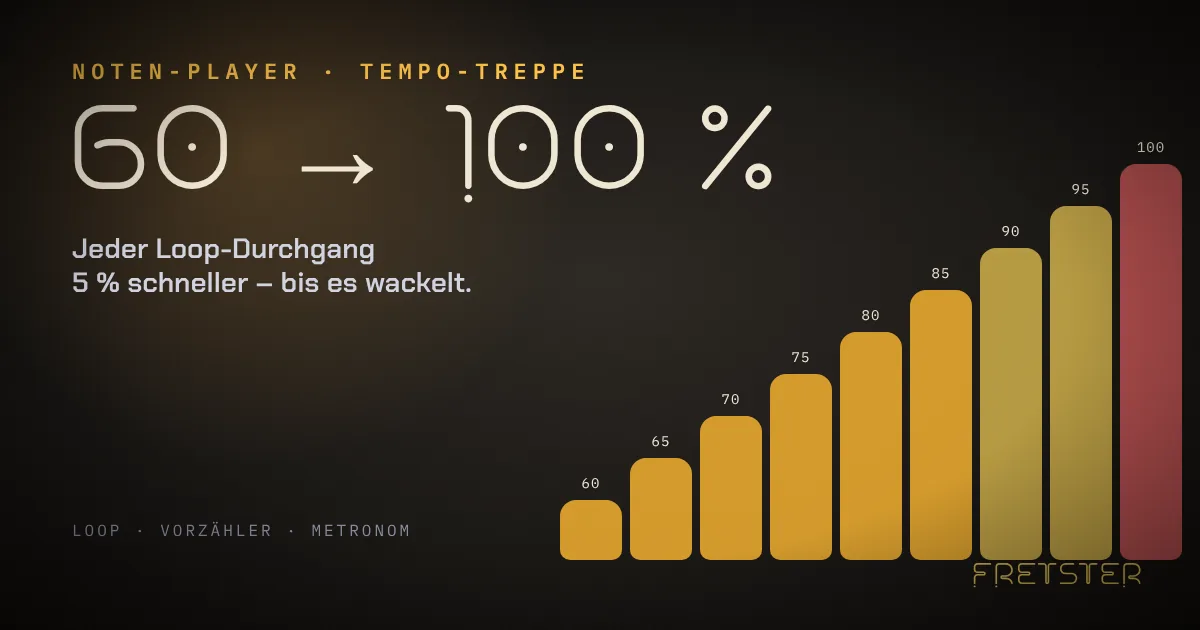
This is where the sheet music player takes over. Set the loop to the passage and switch on the tempo ladder: it starts at 60 percent of the target tempo and gets five percent faster after every pass until it reaches 100. You don't turn or count anything – just play along and listen for the percentage at which it starts to wobble. That is your tempo for tomorrow.
Why small steps? Because that is how motor skills learn: a movement that works at 60 almost always works at 65 too. At 90 it doesn't. The jump from "slow and clean" to "target tempo" is the moment most people lose everything they have just built. The ladder removes it.
The count-in in the player helps you not to start too early; if you like, let the player's metronome run along. And if you learn better by ear: you can also just listen to the track you are practising and play it in your head – that counts too; studies on mental practice show measurable effects on motor skills.
Step 5: One run-through – without stopping (2 minutes)
Finally the whole piece once at a comfortable tempo, and whatever happens: don't stop. This is the rehearsal for the performance, even if the performance is only the family in the kitchen. Mistakes are not fixed, only noted – they are tomorrow's spots.
Set the tempo for this run on the metronome, not by feel. By feel everyone starts too fast, because the beginning is easy, and then collapses at the first hard spot.
The 15-minute plan at a glance
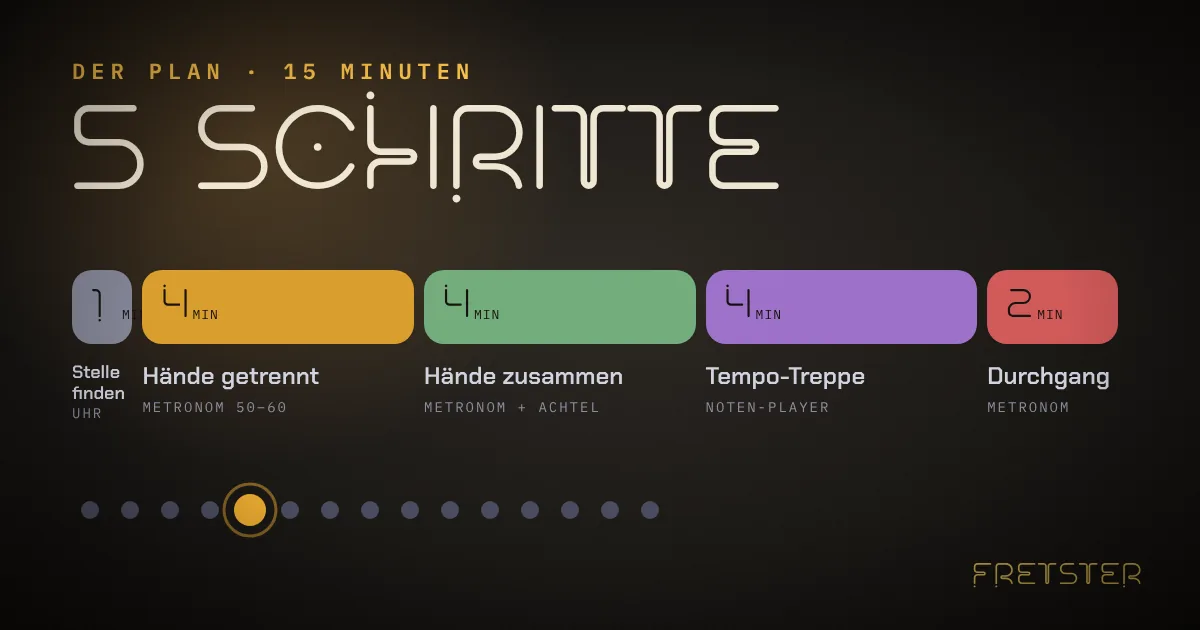
- Minute 0–1 – play through once, mark the spots (clock).
- Minute 1–5 – hands separately, slow, no mistakes (metronome 50–60).
- Minute 5–9 – hands together, three times right, then faster (metronome with subdivision).
- Minute 9–13 – loop and tempo ladder from 60 to 100 percent (sheet music player).
- Minute 13–15 – one run-through without stopping (metronome at target tempo).
Five days like this, and the spot that doesn't work today is no longer a spot next week. Children do the same plan in 10 minutes – and with the kids' view in the player, which shows the notes large and with their names.
When that isn't enough – and where a teacher is faster
The metronome and the player make visible what you play. What they can't do is tell you why the passage doesn't work. Whether it is the fingering, the hand position, a thumb that tucks under too late, or simply a rhythm you misread – a teacher sees that in ten seconds, and on your own you search for three weeks.
That is exactly what we do in piano lessons in Munich: not play pieces to you, but show you how to practise. At both locations – Obersendling in the south and Allach in the north-west, right on the border with Karlsfeld – for children from 5, adults and everyone coming back to the piano as an adult. The trial lesson is free for children; adults simply get in touch, and we look together at where it catches.
Until then: clock, metronome, player. Fifteen minutes. Again tomorrow.