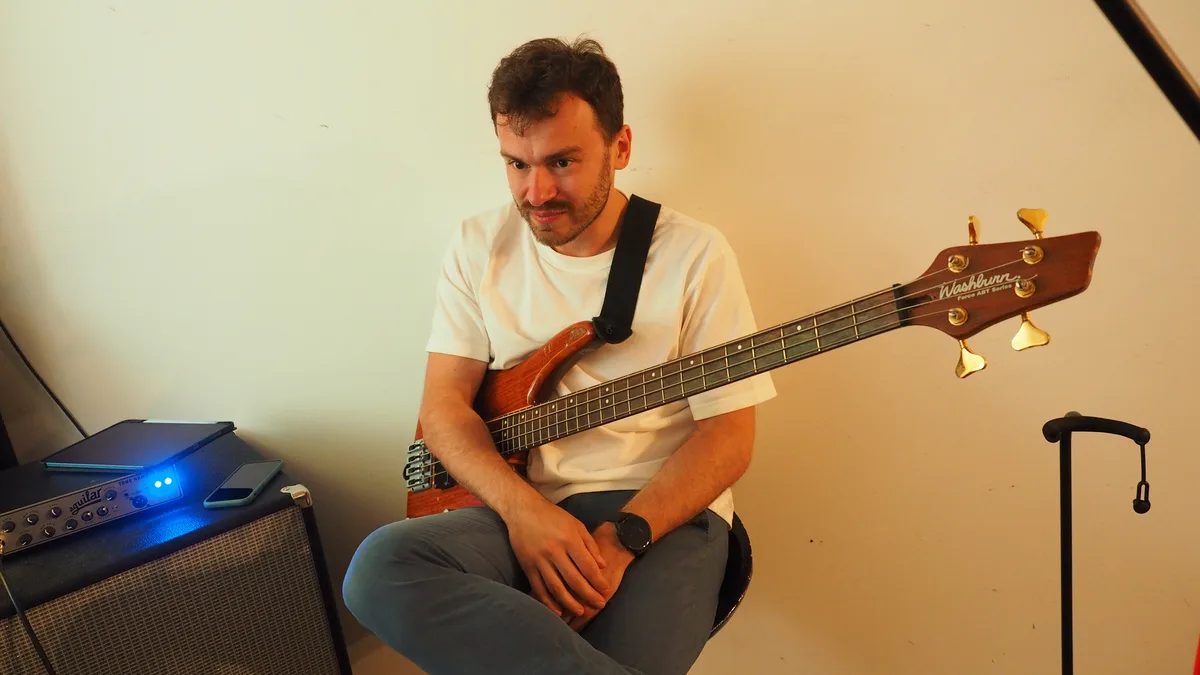
My name is Pavel Semenchuk. I am a jazz bassist, I run Fretster Music Academy in Munich, and I am writing this because for years I have been thinking about something almost nobody talks about: what happens when a door closes and all that is left in the room is a child, an adult and an instrument.
It sounds like nothing. Just a music lesson. But I am convinced that this hour is one of the rarest situations in a child's life – and one of the most underrated.
Where else does a child sit for 45 minutes with an adult who wants nothing from them?
Count for yourself. At school a child sits in a room with 25 others, and the teacher has to speak to all of them at once – I have taught at a Gymnasium, a Realschule and a Mittelschule myself, and I know how little of a lesson reaches one particular child. Not out of ill will, out of arithmetic. At home there are parents, who love the child and for exactly that reason are not neutral. In sport there is the team. At the doctor's, ten minutes.
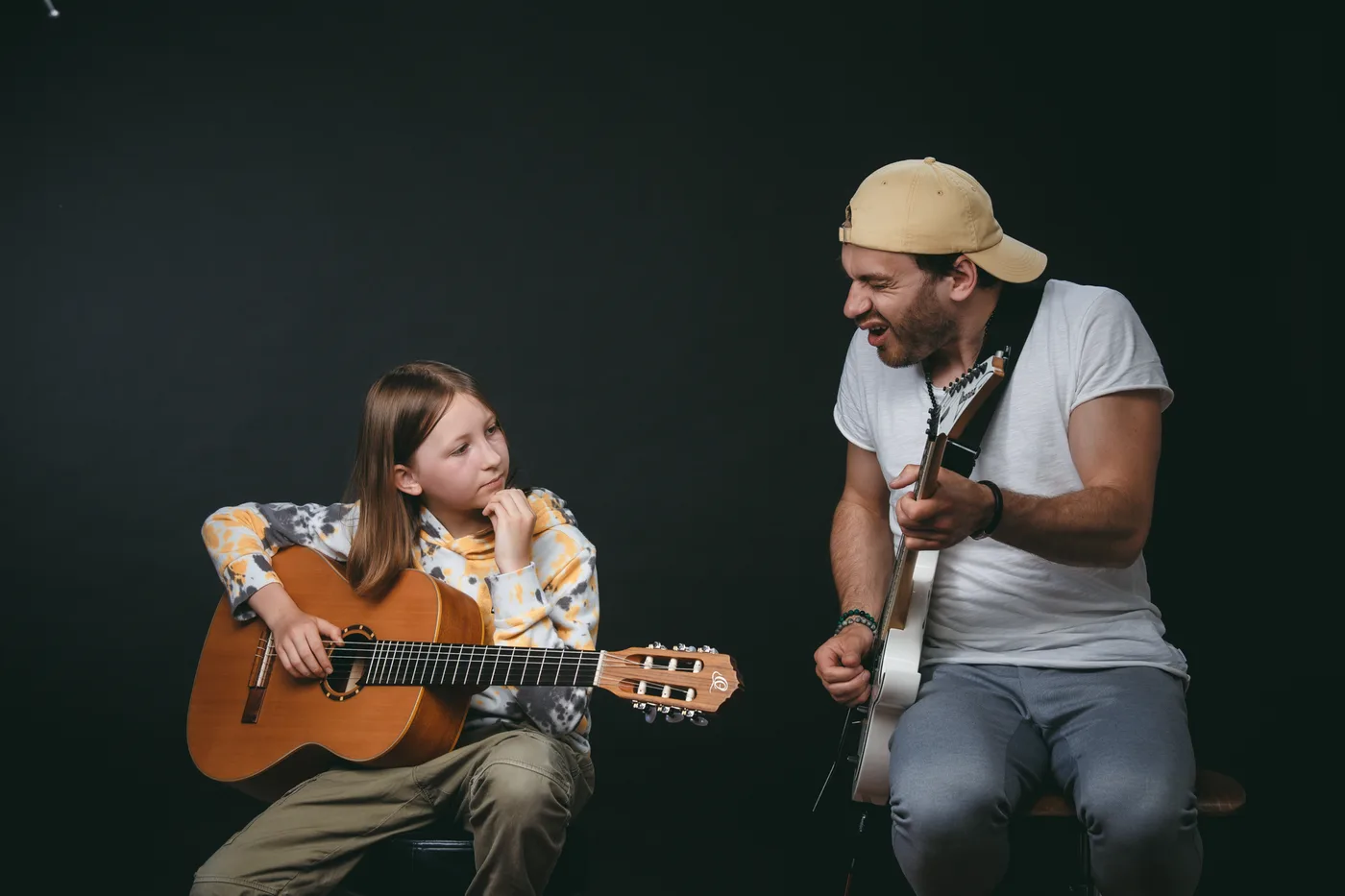
And then there is this one hour a week when an adult who is neither a parent nor a schoolteacher is there for this one child only. There is nothing to grade for a report card. They want nothing except that it gets a little better than last week. The pace is the child's pace. If something does not work, nobody is waiting behind them.
I believe a great many adults would have needed exactly that hour in their childhood. And I know that many adults still need it today – which is why people of 40 or 60 sit at an instrument with us too, and the door closes just the same.
Why I take this so seriously: my own story
I grew up in Taganrog, a port town in southern Russia. As a child I had a music teacher who spoiled music for me for a long time. Not with shouting, not with hitting – simply by the way he treated a child who could not do something yet. It took me years to find my way back. Later I did three courses of study – double bass, bass guitar, music production –, I have played piano for over thirty years, and today I stand on stage as a bassist and bandleader. But I never forgot that one teacher.
Recently I wrote to him. Not to settle a score – to say thank you, for everything he taught me all the same. The mistake was real, and it matters to name it. But without him I would not be the musician I am. Both things are true, and an adult is allowed to know both at once.
Out of that came the most important rule of my school, and it stands above everything else: a child should want to play for the rest of their life. Not play well until the next exam. Not practise obediently until the recital. Want to. At 15, at 30, at 70. Everything we do in a lesson is measured against that rule. If a method brings fast progress but eats the wanting, it goes.
What really happens in that hour
From the outside you see: a child plays, an adult listens and says something. From the inside, something else happens.
Mistakes become data. When a child hits a wrong note there are two ways to react. One is: "Wrong, again." The other is: "Listen – the third note, was it higher or lower than the one you wanted?" In the first case the child learns that mistakes are embarrassing. In the second it learns to hear mistakes. Psychology draws a very precise line here between shame ("I am bad") and guilt ("I did something wrong"): shame makes people hide and quit, guilt makes them fix the mistake (Tangney and colleagues have studied this for decades). In our rooms there is no shame. A mistake is information, not a verdict on the person.
"I didn't have time" is not an interrogation. Almost every week someone turns up who has not practised. I do not ask why. I ask when in the week five minutes would have been possible – after dinner, before the phone? Then we build the exercise in exactly there. That is not kindness, it is research: concrete if-then plans ("after dinner, before I turn on my phone, five minutes of guitar") clearly raise the chance that something gets done (Gollwitzer). And a habit takes about two months on average to form, for some people much longer (Lally and colleagues, 2010). In those weeks a child needs someone who adjusts the plan, not someone who scolds.
Five minutes a day beat an hour on Sunday. That is not an opinion but one of the most stable findings in the science of learning: spaced practice sticks better than massed practice (Cepeda and colleagues summarised hundreds of studies on it in 2006). So the lesson for two is not the place where practising happens. It is the place where we find out which five minutes are the right ones in the six days in between.
The pace belongs to the child. It sounds trivial, but it is the real reason one-to-one teaching works so strongly. In 1984 the education researcher Benjamin Bloom showed that pupils with their own tutor did better on average than 98 per cent of a normal class – the famous "two sigma problem". Later, more sober analyses find smaller but still large effects (VanLehn in 2011 put human tutoring at about 0.8 standard deviations). Why? Because a tutor stops at exactly the point where it sticks – and in a class that point is somewhere different for every child.
What music can do – and what it cannot
I want to be honest here, because I dislike the promises of my industry. Music does not save lives. Music lessons do not make children "smarter" either – the large meta-analysis by Sala and Gobet (2017) took that myth apart fairly thoroughly: a transfer from music lessons to maths or intelligence cannot be cleanly demonstrated. Anyone selling you otherwise is selling you something.
What music demonstrably can do interests me far more. People who play regularly hear differently: the brain processes sound more finely, including speech in noise (Nina Kraus's work has shown this for years). And – this is the part I truly believe in – music made together connects people faster than almost anything else. Four-year-olds who have sung and drummed together help each other more afterwards than children who merely played together (Kirschner and Tomasello, 2010). Adults who sing together feel closer to each other after a single session than groups who do crafts or creative writing together – researchers call it the "ice-breaker effect" (Pearce, Launay and Dunbar, 2015).
So music does not help you survive. It helps you live: find friends, belong to a group, be able to do something nobody can take away. For a child who does not shine at school, the band on Thursday may be the only place where they are needed. For an adult new to Munich, the weekend jam session may be the first evening with people who do not ask what they do for a living.
Why I have spent years looking for the simplest explanation
There is a second reason the lesson for two is so valuable: you can explain there. Really explain, until it sticks. And over the years I have noticed something that still annoys me: almost everyone explains how something is built. Almost nobody explains why.
"A major chord consists of root, third and fifth." Lovely. But why those of all notes? "Minor sounds sad." What is physically different, and is that even true? "Count one-two-three-four." What exactly are you counting?
I have spent years finding the simplest explanations for the most complicated things – and the simplest one is almost always the one that goes down a floor, to physics, to history, to the instrument. An example I give every beginner within the first lessons:
What is a key? Everyone says: "It's the sharps and flats at the start of the line." That is like saying a house is its house number. A key is a home. Of the twelve notes that exist, a song lives in seven – and one of them is the front door, the note where the song comes to rest. Play a children's song and stop one note before the end. That feeling that something is left open – that is the key calling you home. Major and minor are just two different floor plans of the same house. Any child understands that in three minutes, and does not have to memorise a single sharp.
Or rhythm: the pulse is the thing that does not get faster. Rhythm is how many pieces you cut the time in between into – like a pizza. And if you cut the pieces faster and faster, several hundred times a second, you no longer hear a rhythm but a pitch. Pitch is the same rhythm, only very fast: concert A vibrates 440 times a second. Once you have understood that, no theory book can frighten you again.
That is why I build all of this
Once you have understood how valuable this one hour is, you want to protect it. And you notice: the hour alone is not enough. Six days lie in between, and in those six days it is decided whether a child is still playing in a year.
That is why Fretster Music Academy has become more than a music school. We built a method that breaks every piece down into four skills – rhythm, motor skills, ear, theory – so that a child can see what they can already do and what comes next. We built free mini apps that do between lessons what a note saying "practise!" used to be supposed to do: a metronome that opens the homework on the phone at the right tempo, an Ear Path, a Drum Studio, a play-along with a band. We are writing a comic magazine in which a small robot called Fred – a deleted, imperfect version of a great music machine – teaches children to listen, because he of all characters understands best what it is like when something does not work. There is a printed Skill Pass with stickers, worksheets, sheet music, stories about musicians.
And I never stop learning. Every week something new is added – for a while now with artificial intelligence as a tool: methods, mini apps and worksheets that I could not build for years because I could not code now take shape in days and land in the next lesson. The pace is, frankly, crazy. But the yardstick stays the same: what counts is not what I can build, but what arrives in the hour when the door closes.
All of that is a lot of work, and people sometimes ask me why a small school in Obersendling and Allach builds such things. The answer is always the same: because I am not looking for the simplest explanations for myself, but for the hour when the door closes.
And the most important thing: the door opens again
The lesson for two is the beginning, not the goal. The goal is the moment the child comes out of the room and plays with others. That is why we have bands from the first year – not as a reward for advanced players, but as a way of learning. That is why there is the free jam session in Allach, which children and adults can come to even if they have never been to us, simply to see how we work. That is why there are band workshops and holiday courses where people meet who would otherwise never have crossed paths.
The word I use for this is community. Not as a marketing term, but as what is left when you take the lessons away: people who know each other because of music and come back because of each other. A music school without that is just a timetable.
There is a person I never met and to whom I nevertheless owe a lot: a pianist and teacher in Rostov-on-Don who in the 1970s built the country's first jazz department and whose school is still working today. The people who teach there have always been my model: adults who free up time for children to play, instead of occupying it with themselves. I will write about him another time. For today the rule I took from there is enough: ensemble from the first year, talk little, never be a figure of authority.
What you can do now
If you have a child who might want to play: book a trial lesson – it is the most direct way to see the door from the inside once. Or come to a jam session first and just watch; you do not have to promise anything for that. If you are an adult who has been thinking "one day I'll learn that" for twenty years: the door closes for you just the same as for a child, and nobody is waiting behind you.
And if you take only one thing from this text, let it be this: play a song you know tonight, and stop one note before the end. The feeling that remains is the beginning of everything.
Ask for a trial lesson · Free jam session in Allach · Music lessons for children
Sources I draw on: Tangney, Stuewig & Mashek (2007), "Moral emotions and moral behavior", Annual Review of Psychology; Gollwitzer & Sheeran (2006), meta-analysis on implementation intentions; Lally et al. (2010), European Journal of Social Psychology; Cepeda et al. (2006), Psychological Bulletin; Bloom (1984), "The 2 Sigma Problem", Educational Researcher; VanLehn (2011), Educational Psychologist; Sala & Gobet (2017), Educational Research Review; Kirschner & Tomasello (2010), Evolution and Human Behavior; Pearce, Launay & Dunbar (2015), Royal Society Open Science; Kraus & Chandrasekaran (2010), Nature Reviews Neuroscience.