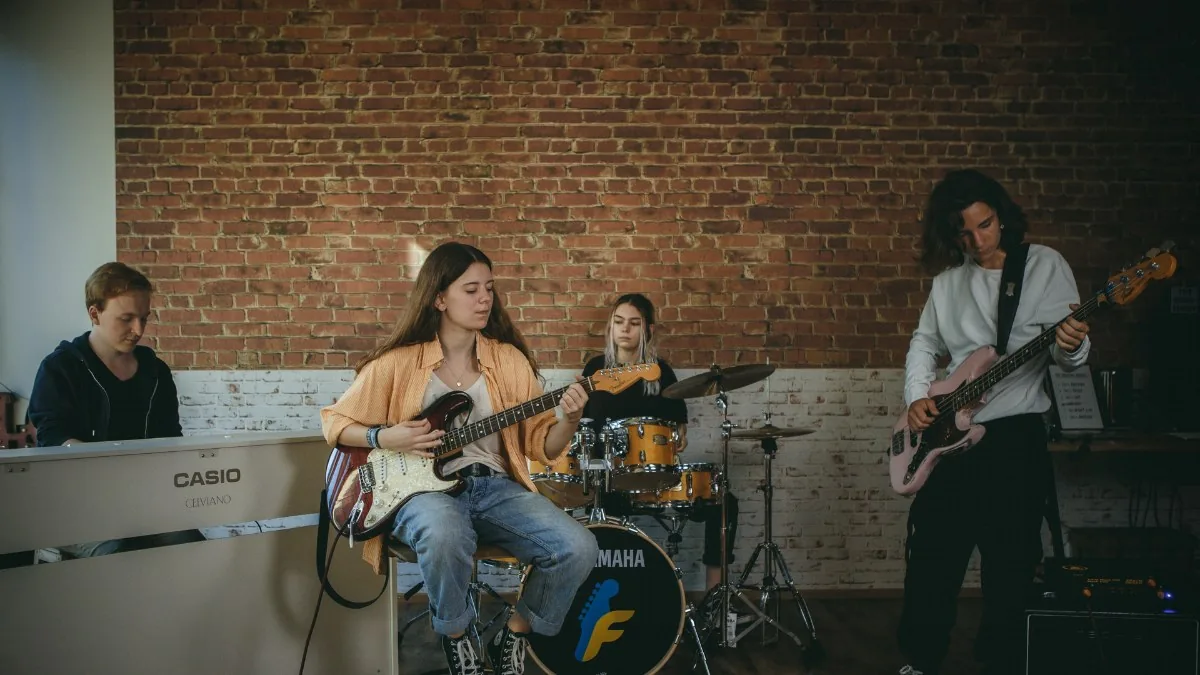
Munich has dozens of music schools: municipal, private, franchise chains, individual teachers. The websites all look alike – "qualified teachers", "individual support", "free trial lesson". The difference only shows in the trial lesson itself. And only if you ask the right questions.
We teach ourselves – and we know which questions parents should ask us (and which they rarely do). Here are eight of them. They apply to every school, including ours.
1. Who will teach my child – and does that teacher still perform?
The most important question, and the one asked least often. Ask for the name of the actual teacher, not "our team". Do they still play concerts? What kind of music? How long have they been teaching children?
A musician who stands on stage every week brings two things no textbook teaches: they know what practice feels like when it counts – and they notice immediately when something doesn't groove. At Fretster, active musicians teach; the founder is a jazz bassist and bandleader. That is not proof of quality in itself – but wherever you go, ask who exactly will be sitting across from your child.
2. What will my child be able to do in three months? In a year?
A good school can answer this – concretely, not with "every child is different". For example: after three months, four chords and a first song with accompaniment; after a year, a small repertoire and the first band rehearsal.
If the answer stays vague, there is no plan. Then everything depends on what the teacher happens to think of that day. We work with a learning plan per instrument: every skill is a node, visibly ticked off. Not every school has to do it this way – but there should be some form of goal.
3. Will my child play with others – or only alone with the teacher?
Private lessons are the standard, and for technique they are irreplaceable. But music is a team sport. In review studies of music education (Hallam, 2010), the best-supported effects of making music include the social ones: belonging, cooperation, motivation from the group. "I only practise alone in my room" is one of the sentences we hear most often from children who quit elsewhere.
So ask: are there ensembles, bands, joint performances? From when? How often? With us, the band is the goal from day one – this is how the band programme works. But a school orchestra or a guitar ensemble counts too. The main thing is that your child doesn't only play for the wall.
4. How long is a lesson, and how often?
For six-year-olds, 30 minutes is right – attention doesn't last longer, and anything beyond that you pay for nothing. For ten-year-olds 30 to 45, for teenagers and adults 45 to 60. Once a week is the standard; more important than a second lesson is what happens between lessons.
Here is a follow-up question that reveals a lot: "What should my child practise at home, and for how long?" The honest answer is not "an hour every day". It is: short, often, with a concrete goal. Why practising well matters more than practising long – we wrote a separate article about that.
5. What does it really cost?
The monthly price is only half the truth. Ask about:
- Contract length and notice period. A twelve-month minimum term is common at music schools, but not the only option.
- Holidays. Are there lessons during the Bavarian school holidays? If not, is the month still charged in full?
- Cancellations. What happens if your child is ill? If the teacher is?
- Instrument. Do I have to buy one right away? Are there rental instruments?
- Extras. Do performances, recordings or sheet music cost extra?
A school that doesn't show its prices on the website usually has a reason. Ours are here, including the band programme and the 10-lesson card.
6. What happens in the trial lesson – and does it cost anything?
A trial lesson is not a sales pitch but a real lesson: instrument in hand, first note, first feedback. Afterwards you should know three things: did my child enjoy it? Did the teacher see them – really see them, not run through a script? And what would the next step be?
For children, the trial lesson with us is free. Wherever you take it: go in with your child. A school that keeps parents outside the door either has something to hide – or simply no culture of openness.
7. Where and when – and can I really manage it every week?
The best school is useless if the journey becomes a weekly battle. Be honest: travel time, parking or public transport, the afternoon slot, siblings. Twenty extra minutes each way is 70 hours a year.
Also ask how flexible the times are when the school timetable changes – which happens every half-year. We have two locations, Obersendling and Allach, precisely for that reason.
8. What does the school do when my child doesn't want to practise anymore?
This question surprises most schools. Yet it is decisive, because the moment comes – for almost every child, usually between month six and month twelve. The answer shows whether the school has a concept or just sells lessons.
Good answers sound like this: change the repertoire, set a concrete goal (a gig, a recording), put the child in a band, make practice shorter and clearer. Bad answers sound like this: "That's normal, you just have to push through." How to motivate your child to practise without pressure – we have an article on that too.
Three red flags
- No trial lesson, only a "consultation". You are supposed to buy something before you've seen it.
- The teacher keeps changing. Ask how long the current teacher has been there. For children, the bond with the teacher is half the learning success.
- Only private lessons, no performances, no group. After a year your child will have learned a few pieces – and have no one to play them to.
And one question for yourself
Do you want your child to learn an instrument – or to make music? That is not the same thing. For the first, almost any decent school will do. For the second, you need bandmates, a stage and someone who gets your child there.
If you'd like to try: request a trial lesson – free for children, in Obersendling or Allach. And feel free to ask us all eight questions.
Source: Hallam, S. (2010). The power of music: Its impact on the intellectual, social and personal development of children and young people. International Journal of Music Education, 28(3), 269–289.