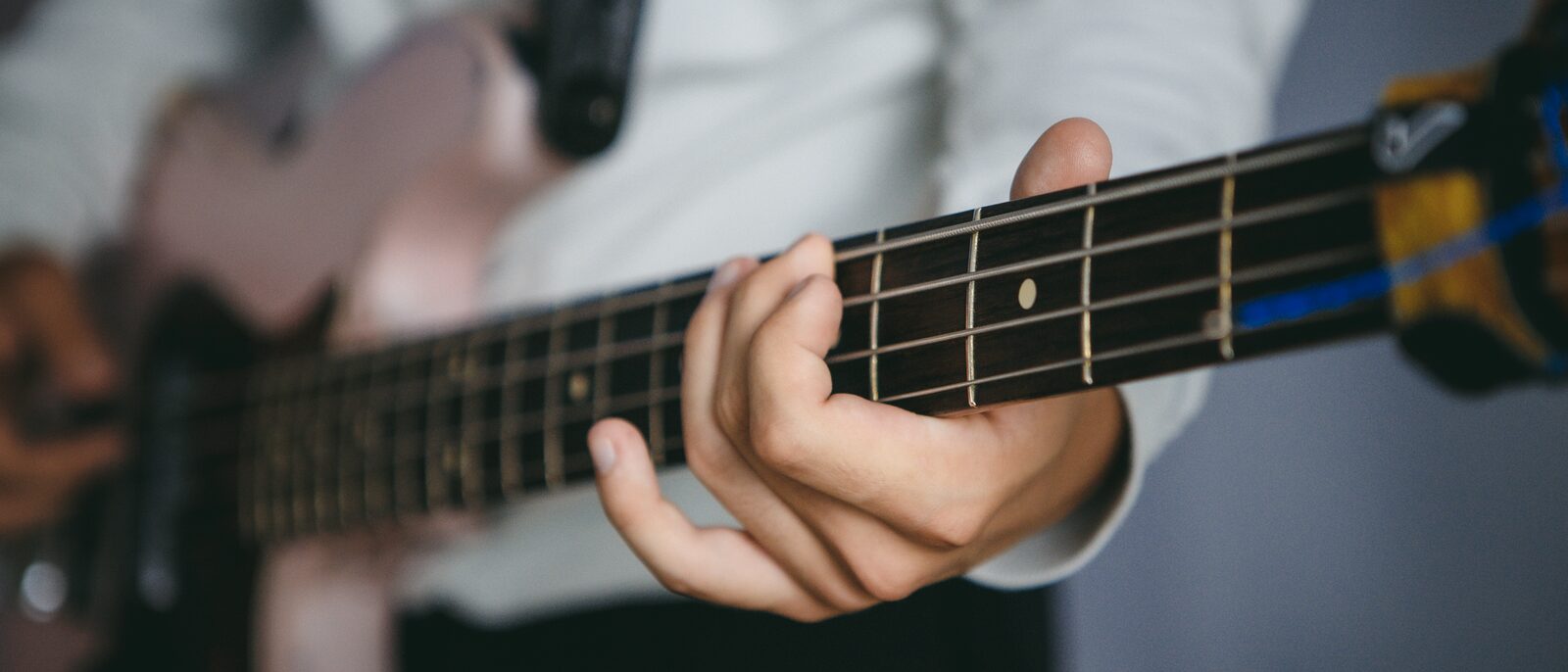
What gets measured is what this hand does — not how long it practised
The picture
THE WATCHWhy one tree and many small apps — instead of one big one.
Runners wear a sports watch. The watch does not run for you. It measures, lines things up and tells you where you stand.
This is built the same way. The tree is the watch — it holds order, prerequisites and the goal. The mini-apps are the sensors — each measures exactly one thing.
The practising still happens on the instrument. No screen replaces fingers. What a screen can do: say straight away whether it was right.
„A node without an app is decoration.“The rule every node in this project is checked against
Hands on
THE TREETake a node and pull. The connections hold.
Drag · Click · Let go
Rhythm · circle
Motor skills · square
Ear · triangle
Theory · hexagon
Milestone
Level 1, Motor skills: Posture & picking. Measured with Motorik Gym. Passed when: Two minutes of alternate picking at 60 BPM, every note equally loud.
Level 1, Rhythm: Pulse & quarters. Measured with Metronome. Passed when: Clap along for four bars without drifting.
Level 1, Ear: Higher or lower. Measured with Ear Training. Passed when: Ten out of twelve note pairs placed correctly.
Level 1, Theory: Note names. Measured with HARMONIA. Passed when: Name every open string without counting.
Level 2, Motor skills: Alternate picking 4/4. Measured with Motorik Gym. Passed when: 90 BPM, two minutes straight, evenly.
Level 2, Rhythm: Eighths & shuffle. Measured with Rhythm Blocks. Passed when: Shuffle feel at 84 BPM over eight bars.
Level 2, Ear: Hearing fifths. Measured with Ear Training. Passed when: Eight out of ten fifths recognised without an instrument.
Level 2, Theory: First chords. Measured with Chord tool. Passed when: E, A and D ring cleanly, changes under two seconds.
Level 3, Motor skills: Barre. Measured with Motorik Gym. Passed when: F barre, every note rings, held for four bars.
Level 3, Rhythm: 16th feel. Measured with Rhythm Blocks. Passed when: 16ths at 70 BPM, cleanly subdivided.
Level 3, Ear: Hearing changes. Measured with Ear Quest. Passed when: Pick out I–IV–V by ear, no sheet in front of you.
Level 3, Theory: Circle of fifths. Measured with HARMONIA. Passed when: Name any key in under five seconds.
Level 4, Rhythm: Free blues solo. Measured with Phrase Studio. Passed when: Twelve bars over a blues in A, without a template.
Level 4, Motor skills: Playing along in a jam. Measured with Jam Station. Passed when: Play Autumn Leaves along, without stopping.
A level is not a year and not a grade. It is depth: level 3 means two layers of prerequisites sit underneath. Someone can be at level 4 in rhythm and level 1 in motor skills — the pillars are independent.
Shown here is the path for guitar. Every instrument gets its own tree, because it is not only the nodes that differ but the order: the guitarist starts with form, the pianist with the five-finger exercise, the drummer with the ear. What they share is the library underneath.
The tree as a printed book
A finished tree can be printed — a personal booklet for this one student, with their goal and their order. The mini-apps then sit next to it as training gear. Not every afternoon has to happen in front of a screen, and software does not replace a living teacher. It is not meant to.
in progress
The sensors
TOOLSFifteen small programs. Each measures one thing.
Five run openly on this page — no sign-up, straight away. The rest run while teaching and are being finished for student access. What does not work yet is listed here too.
RHYTHMTime · pulse · subdivision
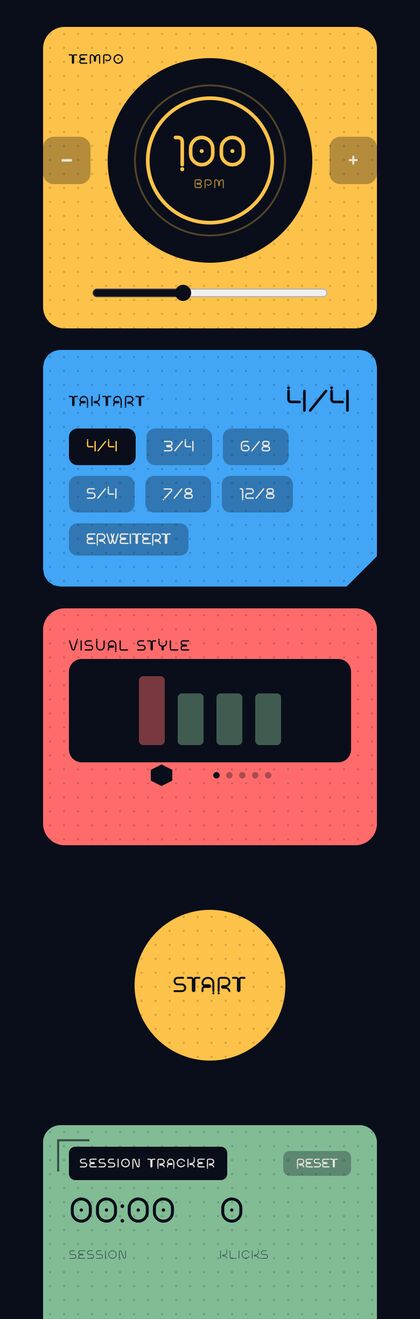
Metronome
Time signatures from 4/4 to 12/8, subdivisions, tap tempo, session counter. The blocks can be moved and hidden.
Scales, degrees and the circle of fifths as one connected map instead of a cheat sheet.
In lessons
Phrase Studio
A library of real licks with notation, tab, sound and a moving cursor. Plus: by whom, from which year, why it sounds like that.
In lessons
Genre History
The series „The Tree“: one branch, one musician, one story. Facts, no song lyrics.
In lessons
Note Strike
Sight-reading as a reaction game. The only thing here that really is a game — and it still measures something.
In lessons
Pinboard
The cards a teacher hangs on a node: the task, a sentence about it, a deadline. The link between the lesson and the week.
In lessons
WHAT IT LOOKS LIKErendered 1:1 from the app
No mock-ups and no polished renderings: these are the real parts, drawn with the same values they run on inside the app.
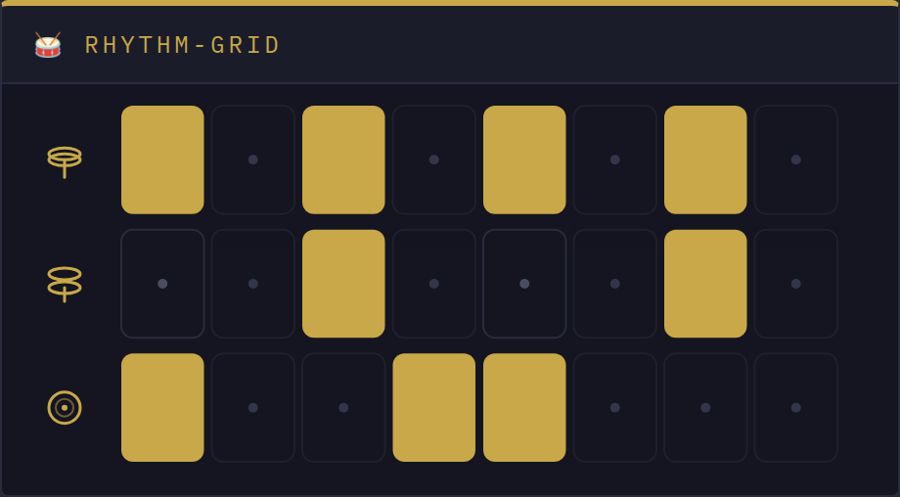
Rhythm grid · works
Lay out a pattern and hear it. What is missing: any evaluation of whether the student hit it — nobody counts that yet.
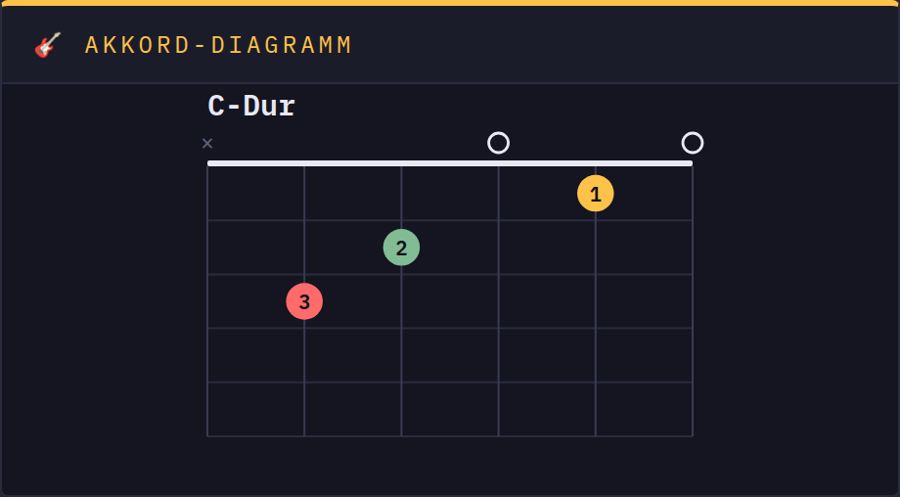
Chord diagram · works
Grip with fingering, open and muted strings. Open in the tool on this site, attachable to a node in the app.
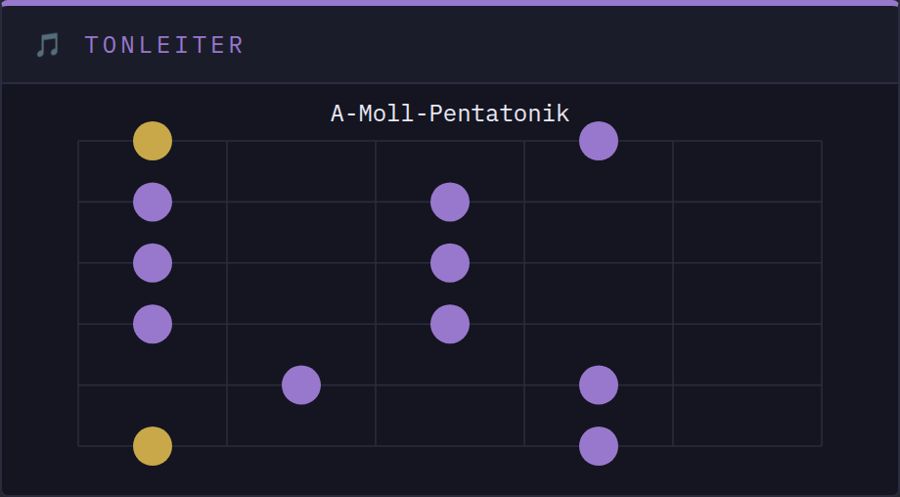
Scale · works
A pattern with the root notes highlighted. Still silent — tap and hear is still to come.
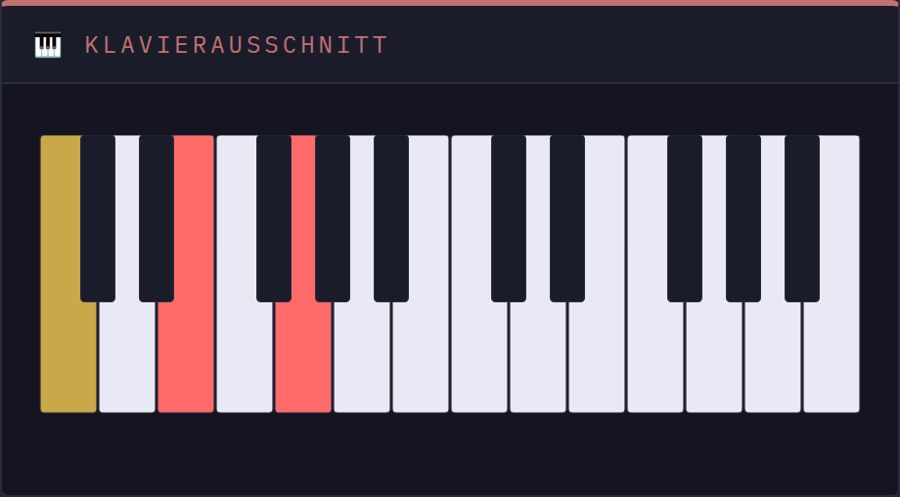
Piano section · half done
Shows chord tones on the keyboard. Meant for guitarists to understand harmony — for actual piano lessons the range is not enough yet.
The skill tree itself and Phrase Studio are teacher views and therefore not shown here — they contain real student data. What the tree should look like is above, hands on.
Metronome · live on this site
Every tool is a surface made of blocks you can move, hide and add back — there is no second view and no „pro mode“. Whoever needs more adds a block.
That is not a design gimmick: those same blocks are the measuring points of the tree. Whoever holds eight clean bars at 84 BPM in the metronome has passed the node „Eighths & shuffle“ — without anyone sitting next to them counting.
The library
CARDS603 phrases. Each one belongs to a real musician.
A node says what has to hold. A card says what it sounds like when someone can do it. Every card carries a figure, notation and tab, the sound and a moving marker — plus the name of the person who plays it that way.
B. B. Kingbends into the sixth and lets it back down under control.
Albert Kingbends the fifth into the minor seventh — left-handed, strings pulled downward.
Rocco Prestialeaves the ONE silent. The groove comes out of the hole.
Larry Grahamthumb on 1 and 3, pop on 2 and 4. Nothing more is needed.
Marcus Millerslaps with hammer-ons — two notes, one stroke.
Charles Mingusleaps wide and pushes back chromatically.
Why this matters
So that a student sounds like someone they know, not like a program. A figure you can attach to a name sticks. An anonymous exercise does not.
About rights, openly
We do not print other people's transcriptions. The cards are our own figures in the style of the musician, with the source named. Work details — composer, album, key, tempo — are facts and may stand.
Evidence instead of claims
RESEARCHWhat the studies actually say — even where it makes us look smaller.
Half the industry advertises „two standard deviations“. We do not, because the number does not hold. Here is what is established, what is exaggerated, and what follows from it for the tree. Every number with a source.
One-to-one tutoring0.37
standard deviations — the average across 96 randomised tutoring studies. Bloom's famous „two sigma“ came from two dissertations over three weeks. And: 1.1 of those two sigma came from feedback and re-testing, not from the tutoring itself. That is exactly what a tree can deliver.
of the performance differences in music are explained by deliberate practice (meta-analysis, 2014). The biggest single lever a learning program can touch — and the proof that „10,000 hours and you are a pro“ is false. So we do not celebrate hours, we celebrate criteria that were met.
is the optimal gap between two practice sessions if something should hold for half a year (Cepeda 2008). The consequence: a mastered node does not stay green forever. After three weeks untouched it fades and offers itself for a refresh — it is not locked.
advantage in the field — not even significant for young learners (meta-analysis 2024, 54 studies). In the lab interleaving works strongly, in everyday practice barely. So: build new movements in blocks, interleave only when consolidating. And say out loud that interleaving feels worse and still works better.
Hedges' g for relatedness — by far the largest documented effect of gamification (35 interventions, 2,500 participants). On the feeling of competence it barely acts at all, 0.28. Translated: the playful part belongs where a human being is involved, not in a point score.
An expected material reward lowers intrinsic motivation — especially for activities that were already interesting (Deci, Koestner & Ryan). Music is exactly such an activity. What strengthens it: informative praise and feedback that proves ability. What undermines it: „do X, get Y“.
of fifteen-year-olds fall below the minimum level in mathematics. That is not a motivation problem but a prerequisite problem: things keep being built on foundations that do not hold. A tree with gates does not allow that.
of students are at schools with a teacher shortage (2018: 57 %). That is why assessment has to become semi-automatic. A teacher cannot check thirty criteria a week one by one — an app that measures tempo, evenness and hits can do the groundwork. The judgement stays with the human being.
„Streak creep“: users optimise the number instead of the thing, and those who break a streak quit altogether more often than average. That is why there is no daily streak with a threat of loss here — even though it would raise usage numbers in the short term.
What the tree does not solve. In Germany the gap between privileged and disadvantaged students is 111 PISA points and has not moved since 2012. It hangs on the language spoken at home, on quiet space to work, on money for an instrument and on the parents' time. A program can soften that, not remove it. Anyone promising otherwise is selling.
Not newly invented
GIANTSThe idea of a prerequisite tree is sixty years old.
Anyone claiming to have invented the skill tree has not looked it up. The principle is old and well documented. What is new here is something else — and it is in the table below.
1965
Robert Gagné
Learning hierarchies: a skill is taken apart backwards into its prerequisites. You do not teach the upper level before the lower one holds. That is the tree, on paper.
The Conditions of Learning1968
Benjamin Bloom
Mastery learning: no moving on before a criterion is met. Those are the gates.
Learning for Mastery1985
Doignon & Falmagne
Knowledge spaces: a mathematical theory of which sets of knowledge are reachable at all under given prerequisites. It became ALEKS, which has taught mathematics that way for decades.
Knowledge Spaces · ALEKS2012
Khan Academy
The Knowledge Map — thousands of connected nodes shown to students. It was removed again. People still ask for it to come back.
Khan Academy Help Center2022
Duolingo
The best-known skill tree in the world — with levels per node and a strength that decays without practice. Replaced by a linear path in 2022: learners did not know whether they were doing it right.
Duolingo Blog
What already existed — and what did not
Tree
Levels per node
measures execution
teacher in the system
Gagné 1965
yes
no
no
yes
Bloom 1968
no
yes
no
yes
ALEKS
yes
yes
no
no
Khan Academy
yes
yes
no
no
Duolingo
yes
yes
no
no
Fretster
yes
yes
yes
yes
What is genuinely new hereThree things, and the tree is not one of them. First, a node measures an execution, not an answer: milliseconds, evenness, the note actually hit — not a box ticked. Second, the criterion is a sentence a human can check, instead of a probability inside an algorithm. Third, a teacher walks along. On Duolingo the learner stood in front of the map alone — which is exactly what killed it.
The play instinct
PLAYA fifth to a third should be play. The question is: which fifth.
It is the practising that should become playful, not the rewarding. The game elements sit in the shape of the exercise — not in a layer on top of it.
What we build
The moving cursorA marker runs across the notation in tempo. Feedback, immediate and self-explanatory.
The tempo ladder70 ✓ · 80 ✓ · 90 ← the rung lights up. The opponent is yesterday's you.
The drift test„Four minutes without speeding up.“ Then a line: your tempo over time. Flat = passed.
Refresh instead of decayA node fades after three weeks and is suggested again. A lock would be a punishment.
The master as counterpartThe target piece names who wrote it and why. You practise towards a person, not against a machine.
What we deliberately do not build
Points, coins, gems
Purchasable cosmetics
Leaderboards between students
Daily streaks with a threat of loss
Hearts and lives that limit practising
All five fall into the category „expected and material“ — precisely where the overjustification effect is strongest. They would raise the numbers and lower the interest.
Open build log
FUTUREA project that shows only successes is a brochure.
Standing
Website, booking and administration in daily use
Five tools open, no sign-up
Tree editor for the teacher, with cards on the nodes
Phrase Studio with notation, tab and playback
Honestly broken
Progress can only be set with a keyboard on a tabletwhich makes it practically unusable in a lesson
Students cannot start the mini-apps themselves yetso far only the teacher opens them
Three progress bars always show 100 %found during the last review
The levels in the tree carry no visible labelthe tree above shows how it should look
Next
Lesson mode: one screen for 45 minutes
Separate cards for teacher and student
Levels visible, on the phone too
Refresh after three weeks
After that: the same scaffolding for mathematicsthere, too, skill builds on skill
Where it leads: playing together
What happens next
ROADMAPSeptember to May. Including what is not standing yet.
From September the program runs in real lessons. What comes out of that decides the next version — not a wish list.
September – November
Testing with real students
The tree gets used in actual lessons, not demonstrated.
Assignments reach the student through the mini-apps.
One more thing gets measured: how much lesson time goes into working out what comes next.
running
November
Collect the data
Find where students get stuck and which nodes never get opened.
One number of our own instead of other people's studies.
Ship a new version.
planned
December
Clean up
Bugs out.
Whatever nobody used goes out.
Close the gaps listed on this page under “Honestly broken”.
planned
Spring
Live Jam
Students play together over camera — everything points at this.
Entry from a certain standard, so nobody sits in a session that runs them over.
The values for ear and rhythm are visible, like on a player card.
goal
from May
Standing on its own
Individual mini-apps stay free on this page.
The whole thing becomes paid — otherwise it does not carry itself.
Fretster Pocket: a small box with the software, to take along without a computer.
open
One principle we hold to: no new node without a mini-app that measures it. A node without measurement is decoration — and decoration does not go into the tree.
Where money comes in, it goes in this order: first running costs (server, database, licences), then the gaps listed above, then anything new. If something slips, it says so here — not in a press release.
Who builds this
PAVELOne person, one evening after another.
One hand holds, the other reaches — that is the whole point
My name is Pavel Semenchuk and I teach guitar and bass in Munich. The tree came out of teaching, not out of a drawing board.
The reason was mundane: too often I did not know what came next for a student — and that is where most of the time goes. So I started taking skill apart, into pieces small enough that you can see whether they worked.
I build this alone, alongside teaching. That is why this page also says what is broken.
Join in
BUILD WITH USThe software does not carry itself yet.
TechnologyServer, database, domains — they keep running every month, even when nobody practises.
LicencesNotation, sounds, typefaces. Everything from others gets paid for, nothing gets stolen.
EquipmentTablets and microphones in the lesson rooms, so the apps actually arrive there.
Patreon
The best way if you want to follow the project for longer. Monthly, cancel any time.
One-off and immediate. Send money to this address:
Bank transfer
Recipient Pavel Semenchuk, Revolut Bank · BIC REVODEB2. Reference: Fretster App.
Openly: behind this stands a sole proprietorship, not a registered charity. There is no donation receipt and support is not tax-deductible. What comes in goes into development.