Acoustic Guitar Lessons in Munich
The acoustic guitar needs no amplifier — you can play anywhere. Perfect for folk, pop, singer-songwriter, and classic fingerpicking styles. A solid foundation for all other string instruments.
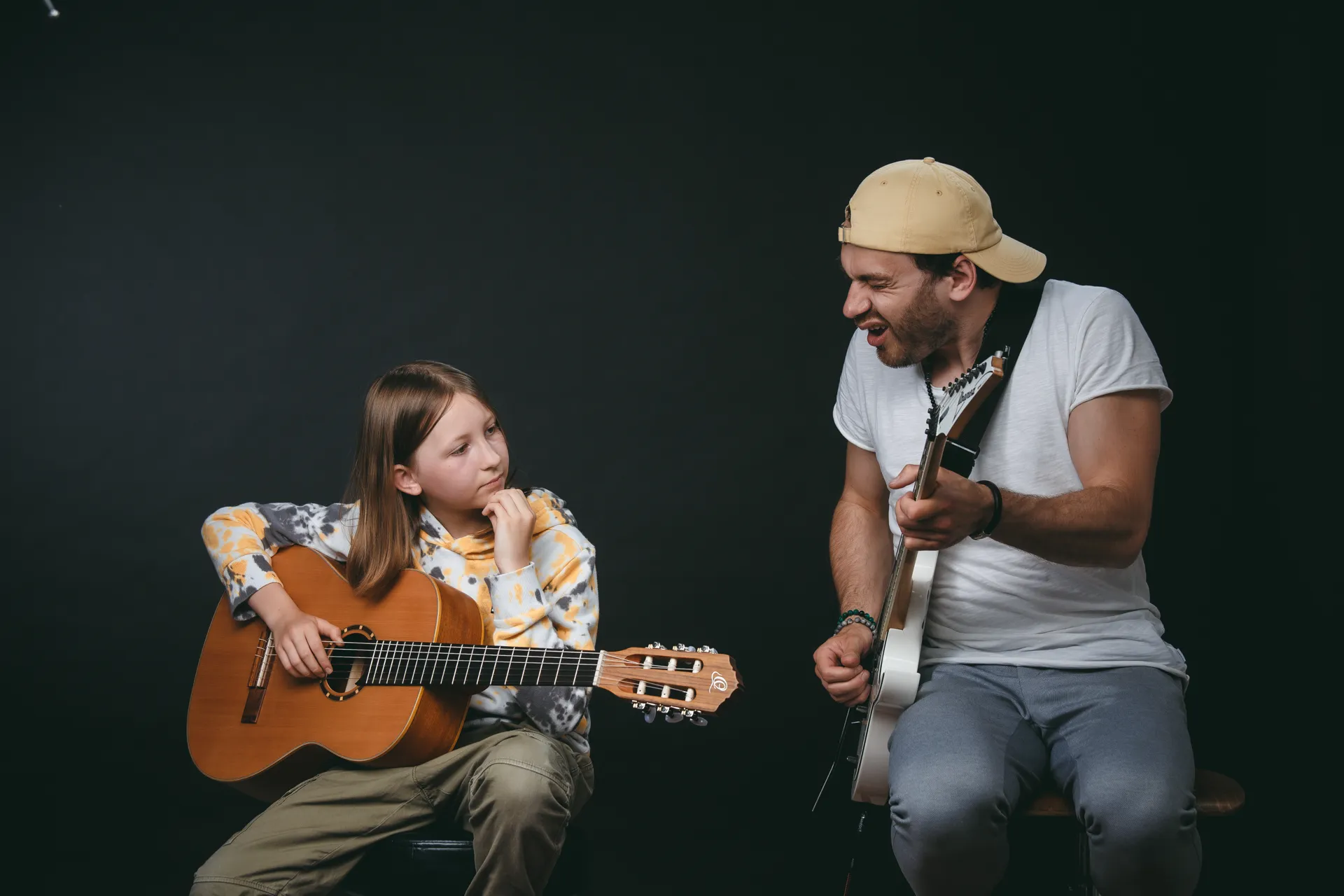
The acoustic guitar is the most honest instrument we teach: no amplifier, no effects, no button that rescues anything. What you play is what people hear. In return it fits in any living room, at any campfire and under any voice. At Fretster you learn chords, strumming and fingerpicking through songs you actually want to play – as a child from age 6, as a teenager or as an adult, in Obersendling and Allach.
Who are acoustic guitar lessons for?
For children from about 6 who are looking for a first instrument: a small classical guitar with nylon strings is light, quiet and gentle on the fingers. For anyone who wants to sing with a guitar – at the kitchen table, at nursery, at a best friend’s wedding. For adults who “knew three chords once” and want to learn properly this time. And for electric guitarists who have noticed that an acoustic makes every sloppy chord audible.
What you do not need: the ability to read music, long fingers or an expensive guitar. What you do need: a 30 to 60 minute lesson each week, and at home ten minutes a day rather than one hour a week.
What a lesson at Fretster looks like
We start with the rhythm of the right hand, because it carries the song: an even stroke on open strings, then the first strumming pattern. Only then do the chords come in – two at first, then the change between them in time. The change is the real task, not the chord shape.
Then fingerpicking: the thumb plays the bass while the fingers pick the higher strings. After a few weeks it already sounds like far more than it is, and it trains finger independence better than any dry exercise. We work with the Fretster method in four areas – rhythm, motor skills, ear and theory. Theory here means understanding why G, C and D together sound like a thousand songs, and how a capo moves the same shapes into your vocal range.
The second half of the lesson belongs to your song. Pop, folk, singer-songwriter, unplugged rock – you bring the piece, and we build an accompaniment you can manage this week. For practice at home our website has a free tuner, a metronome and the Griff-Studio for chords and your own tabs.
Classical or steel-string – and which size?
There are two kinds of acoustic guitar. The classical guitar has nylon strings, a wide neck and a soft, warm tone; it is kind to the fingertips, which makes it the first choice for children. The steel-string guitar has a narrower neck and a louder, brighter sound – the sound of most pop and folk songs. For teenagers and adults who want to accompany songs it is usually the right instrument.
For children, size matters most. As a rough guide: a 1/2 guitar for about 6 to 8 years, 3/4 for about 8 to 11, then 7/8 or full size. What decides is height, not age – a guitar that is too big is the most common reason children tense up. We check this in the trial lesson. Please do not buy anything beforehand.
And yes, your fingertips hurt at first, more on steel strings than on nylon. After two to four weeks of regular playing, calluses form and the problem is gone. Short, frequent practice helps more than long sessions.
How chord changes are really learned – the research
The point where most people give up is the change between two chords. Learning research has an old, well-supported finding on this: people who practise movements in mixed order are slower during the practice session itself, but retain them clearly better than people who repeat one movement a hundred times in a row (Shea & Morgan, 1979). On the guitar that means not ten minutes of nothing but G major, but G, C and D in changing order, even if it feels clumsier.
The second finding concerns the night. In a study at Harvard Medical School (Walker et al., Neuron, 2002), a practised finger sequence became clearly faster after a night of sleep, with no further practice; the same amount of time awake brought almost nothing. That is why ten minutes a day are worth more than an hour on Sunday: you give your brain seven nights instead of one.
What we do not conclude from this is that there are shortcuts. The F major barre chord remains a hurdle for everyone. But with the right order of steps and a well set-up guitar it falls within weeks, not years.
Acoustic guitar lessons in Allach-Untermenzing (Gustav-Otto-Bogen 13)
Our north-west location is at Gustav-Otto-Bogen 13, 80997 München – in Allach, right on the border with Karlsfeld. Guitar students come here from Allach, Untermenzing, Obermenzing, Moosach, Ludwigsfeld and Pasing; for families in Karlsfeld and Dachau it is usually the shortest trip to a guitar lesson. The S2 stops in Allach and in Karlsfeld, and from Moosach it is a short trip by car or bike.
Acoustic guitar in Allach is for children from 6 (classical guitar in 1/2 or 3/4 size), teenagers and adults – afternoons after school, evenings for adults, in English, German or Russian. You don’t need your own guitar to start, and we measure the right size before you buy one. When you get in touch, just add “Allach” and the day you prefer.
Acoustic guitar lessons in Obersendling and Forstenried (Hatzelweg 25)
In the south of Munich we teach at Hatzelweg 25, 81476 München – in Obersendling, near the U3 stop Forstenrieder Allee. The location is convenient for Forstenried, Fürstenried, Solln, Thalkirchen and Sendling – and for anyone who wants to fit in a guitar lesson on the way home from the underground after work.
Here too: children from 6, teenagers, adults and returners, classical and steel-string guitar. Which location suits you better is your call – when you get in touch we ask for your district and preferred day and then suggest a place and time.
How much do acoustic guitar lessons in Munich cost?
One-to-one lessons on a monthly contract: 30 minutes €105, 45 minutes €149, 60 minutes €185 per month. Without a contract: a 10-lesson card (30 minutes €510, 45 minutes €570, 60 minutes €650). Once you can accompany three or four songs steadily, you can move into the band workshop or come to the free Jam Station.
The trial lesson is free for children and teenagers and costs €20 for adults. We have a guitar for you at the trial lesson. After that you decide; there is no automatic contract.
Free practice tools between lessons
Our own mini tools run in the browser, with no sign-up and nothing to install:
Tuner — Tune your strings right in the browser, using your phone’s microphone. Practising out of tune is like learning vocabulary with typos.
Fretboard Studio — Show scales and chords on the fretboard, draw your own shapes, write tabs and print them as a PDF.
Metronome — Tempo, time signatures and a planned practice session. Built for phones, no sign-up.
Sheet music player — Practise notation and tabs with loop and tempo – the hard bar slowly, until it sits.
And when you no longer want to play alone:
Jam Station — Open session: play with others, no fixed programme.
Band workshop — Rehearse songs together – that is how you learn to listen, count and start at the same time.
Give lessons as a present: music lesson gift voucher – from three private lessons, valid for 3 years, as a PDF or for pick-up.
Lessons at two locations: Obersendling/Forstenried · Allach/Karlsfeld · music lessons for kids
Frequently asked questions
- From what age can children learn acoustic guitar?
- From about 6, on a guitar of the right size with nylon strings. Height and the ability to concentrate for 20 to 30 minutes matter more than age. The trial lesson shows this.
- Classical or steel-string guitar to start with?
- For children the classical guitar: nylon strings are softer and the wide neck gives the fingers room. Teenagers and adults who want to accompany pop and folk songs often start straight on a steel-string. Both are fine; the only wrong choice is a guitar in the wrong size.
- Will my fingers hurt at first?
- Yes, a little, especially on steel strings. After two to four weeks of regular playing, calluses form on the fingertips. Short daily practice is better for this than rare long sessions.
- How long until I can play my first song?
- With two or three chords and a simple strumming pattern you can accompany your first song after a few weeks. Getting the changes to flow in time usually takes a few months of regular practice.
- Do I have to read music?
- No. Chord symbols and tablature are enough for accompanying songs, and you pick up both along the way. If you want to play classical guitar or multi-voice fingerpicking from notation, you learn to read step by step.
- Can I switch to electric guitar later?
- At any time. Chords, rhythm and ear carry over completely; what is new is the amplifier, thinner strings and techniques such as bends. Many people end up playing both.
- How much do acoustic guitar lessons at Fretster cost?
- On a monthly contract: 30 minutes €105, 45 minutes €149, 60 minutes €185 per month. Without a contract: a 10-lesson card from €510. The trial lesson is free for children and teenagers, €20 for adults. All prices are on the pricing page.
- Are there acoustic guitar lessons in Allach or Karlsfeld?
- Yes – at Gustav-Otto-Bogen 13 in Allach-Untermenzing, right on the border with Karlsfeld. Students come from Allach, Untermenzing, Moosach, Pasing, Karlsfeld and Dachau. For the south there are acoustic guitar lessons in Obersendling (Hatzelweg 25).
- Do I need my own guitar for the trial lesson?
- No. Both locations have classical and steel-string guitars in several sizes. The trial lesson is free for children and teenagers; adults pay €20 for 30 minutes. Buying a guitar only makes sense after that – and after we have measured the right size.
What students and parents say about Fretster
Fretster Music Academy – Hatzelweg
Hatzelweg 25, 81476 München
Obersendling / Forstenried, south Munich
Read reviews on Google ↗Fretster Music Academy – Allach
Gustav-Otto-Bogen 13, 80997 München
Allach / Untermenzing, Karlsfeld, west Munich
Read reviews on Google ↗
Already learning with us and happy – or know something we should do better? Two minutes on Google help a small music school more than any ad. Write your own review ↗
Stars and texts belong to Google and live there – we can neither edit nor cherry-pick them.